As I sit here reflecting on Finland's political system—from my perspective as someone who's studied and admired how a small Nordic nation has built one of the world's most stable and inclusive democracies—I've often thought about what it would mean to structure a country's political framework drawing directly from Finland's experience. It's not just about copying laws or institutions; it's about embracing principles that prioritize consensus, accountability, and long-term resilience. Let me walk you through my thoughts on this, as if I'm sharing my personal journey of discovery and why I believe Finland offers such a compelling blueprint.
My Fascination with Finland's Balanced Semi-Presidential Model
_(cropped).jpg/250px-Alexander_Stubb_-_2024_(73516)_(cropped).jpg "President of Finland") |
| President of Finland |
I first became fascinated with Finland's model years ago when I read about its transition from a semi-presidential setup with a powerful head of state to the more balanced parliamentary system we see today. The 2000 Constitution was a game-changer, dialing back the president's role to mostly ceremonial and foreign policy duties while making the prime minister and cabinet truly accountable to parliament. In my view, this shift prevented the kind of executive overreach that can plague newer democracies.
If I were advising on structuring a political system, I'd start right there: design a semi-presidential republic where the president is directly elected by the people for a six-year term (with a two-term limit) to provide continuity in foreign affairs and national defense, but ensure real power rests with a prime minister chosen by—and removable by—parliament. That balance has kept Finland stable through economic crises, geopolitical shifts like joining NATO in 2023, and even recent coalition tensions.
The Power of a Proportional, Unicameral Parliament
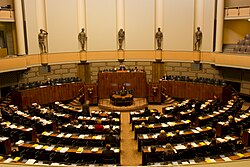 |
| Suomen eduskunta |
The heart of the system, for me, is the unicameral Parliament, the Eduskunta, with its 200 members elected every four years. What draws me in is the proportional representation system using open lists and preferential voting. Voters don't just pick a party; they rank individual candidates, which encourages diversity, boosts women's representation (often around 45%), and reduces the "wasted vote" feeling that fuels populism elsewhere.
I've always believed this setup fosters inclusivity—no single party dominates, so coalitions become the norm. Right now, under Prime Minister Petteri Orpo's center-right government (formed in 2023 and still in place as of 2025), we see the National Coalition Party, Finns Party, Swedish People's Party, and Christian Democrats working together despite ideological differences. It's messy at times—recent scandals and austerity debates show that—but the culture of negotiation usually produces durable majorities that last the full term.
If I were redesigning a country's legislature, I'd push hard for this proportional, multi-party approach over winner-take-all systems. It forces compromise, which in Finland has translated into low corruption, high public trust, and effective welfare policies. Sure, decisions can take longer, but the result is policies with broad buy-in, like the strong social safety net or responses to challenges such as border security reforms or energy transitions.
Why Decentralization Matters to Me
 |
| Municipalities of Finland |
Decentralization is another part of Finland's experience that resonates deeply with me. Power isn't hoarded in Helsinki; it's shared with 309 municipalities handling education, healthcare, and local services, plus 19 regions and special autonomy for the Åland Islands. This setup empowers communities and tailors solutions to local needs while maintaining national standards through fiscal equalization.
In a diverse or geographically spread-out country, I'd argue this is essential to prevent urban-rural divides or feelings of alienation from the center. Finland shows how devolving real authority can make governance feel closer to the people without sacrificing national cohesion.
The Quiet Strength of Checks, Balances, and Trust
What keeps the whole thing humming, in my experience observing it, is the emphasis on checks and balances. An independent judiciary (no separate constitutional court, but Parliament's Constitutional Law Committee reviews laws), strong anti-corruption norms, transparent media, and even tripartite labor negotiations (government, unions, employers) build resilience.
Finland consistently ranks near the top in global democracy and happiness indices because these elements create trust—people believe the system works for them, not just elites. For me, that's the real magic: institutions that earn legitimacy through transparency and performance rather than coercion.
Adapting Finland's Lessons to Other Contexts
.jpg/500px-Petteri-Orpo-01_(cropped).jpg "Prime minister of Finland") |
| Prime minister of Finland |
Of course, Finland's success isn't magic; it's rooted in a relatively homogeneous, educated society with a history of pragmatic consensus-building after tough times like independence in 1917 and the post-WWII era. Applying this elsewhere would require cultural adaptation—strong civic education, minority protections, and perhaps federal tweaks in larger nations.
But the core lessons feel universal to me: prioritize representation over dominance, accountability over centralization, and compromise over confrontation. Reforms like reducing presidential powers in the 1990s-2000s show the system can evolve when needed.
Final Thoughts: A Blueprint Worth Considering
Looking back, studying Finland has convinced me that a well-structured political system isn't about flashy institutions—it's about creating mechanisms that encourage cooperation and adapt over time. If a country wants stability, equity, and citizen trust, starting with Finland's blueprint—proportional parliamentarism, balanced executive, decentralized governance, and a consensus culture—seems like one of the smartest paths forward.
What do you think—could elements of this work where you are? I'd love to hear your take.
AI assistance (Grok) was used to help draft and organize this blog post; the author takes full responsibility for the final content.

No comments:
Post a Comment