Showing posts with label Theology-of-the-Body. Show all posts

Saturday, September 6, 2025

When Love Turned into Struggle: Reflections on Genesis 3:16–17 through the Eyes of John Paul II

When I first sat with the words of Genesis 3:16–17, I felt their weight:

“I will greatly multiply your pains in childbearing; in pain you shall bring forth children, yet your desire shall be for your husband, and he shall rule over you.” (Gen 3:16)

“Because you have listened to the voice of your wife, and have eaten of the tree… cursed is the ground because of you; in toil you shall eat of it all the days of your life.” (Gen 3:17)

At first glance, these words can seem harsh, almost like punishments handed down. But when I turned to John Paul II’s Theology of the Body, I discovered that he read these verses not as God’s arbitrary punishments, but as a revelation of what sin does to the human heart and human relationships.

Broken Communion
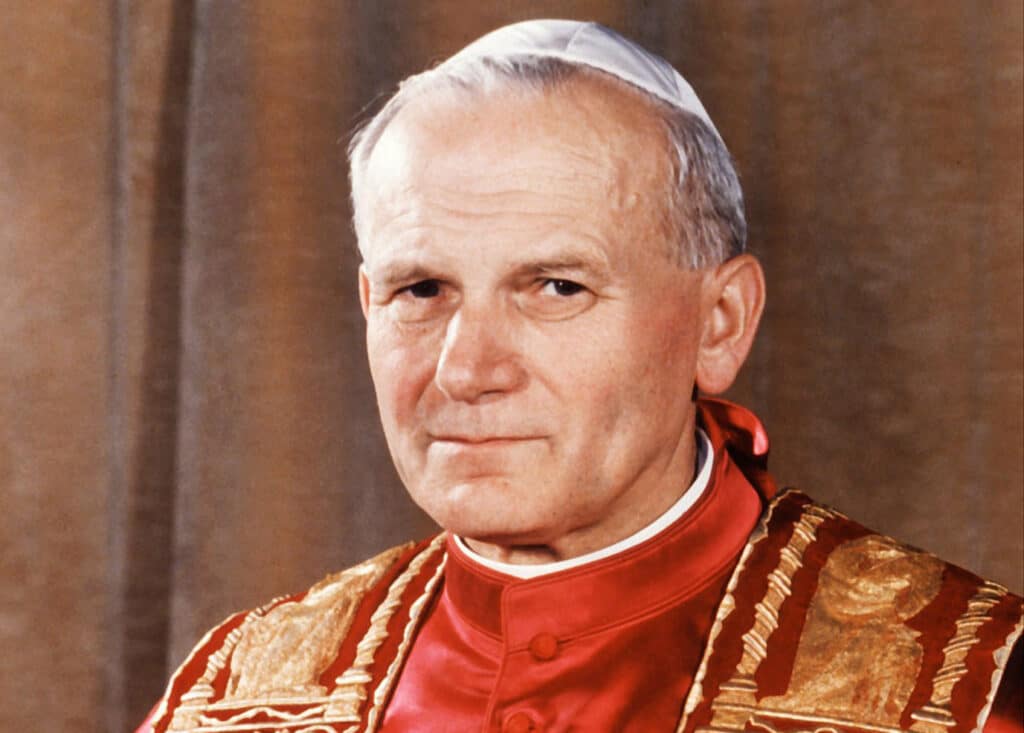
pope-john-paul-2
Pope St. John Paul II

John Paul II explained that before the fall, Adam and Eve lived in perfect harmony — a unity without shame, where each received the other as a gift. But after sin, this unity shattered. The woman’s “desire” for her husband was no longer the pure, reciprocal gift of self. It became marked by concupiscence — the tendency to grasp, to possess, to use.

As JP2 put it:

“Concupiscence brings with it a loss of the interior freedom of the gift. The man becomes the master of the woman… and she will desire this mastership.” (TOB 31:3, October 8, 1980)

In those few words of Genesis, I see the birth of domination, inequality, and the misuse of freedom. The spousal meaning of the body, which was meant for self-giving love, became clouded and distorted.

Toil and Strain with Creation

Genesis 3:17 speaks directly to the man’s work. Once, tending the garden was a joyful participation in God’s creative plan. But after the fall, that same earth resisted. What was meant to be a gift now brought forth thorns, sweat, and toil.

JP2 reflected on this rupture:

“Together with the loss of the original certainty of the image of God, man also lost the certainty of the harmony of his own existence. Work became toil, and birth pains accompanied procreation.” (TOB 27:2, September 24, 1980)

Here I see how sin not only wounded our relationships with each other, but also our relationship with the world we were meant to care for.

Threefold Rupture

Reading TOB, I realized that these verses point to what JP2 often described as the threefold rupture of sin:

  1. A rupture with God (loss of grace).
  2. A rupture with each other (desire vs. domination).
  3. A rupture with creation (toil and suffering).

As JP2 explained, sin’s inheritance is clear:

“This heritage is concupiscence… it consists in the loss of the interior freedom of the gift.” (TOB 32:3, October 15, 1980)

When I look around today, I can still see those ruptures playing out — in broken relationships, in struggles for power, and in our conflict with the environment.

Not the Final Word

But here’s the hope that JP2 never let go of: these verses aren’t the final chapter. They reveal what sin has done, but they also point us toward the need for redemption.

Christ enters into this brokenness and restores what was lost. Where domination once reigned, He shows us love as service. Where toil crushed man’s spirit, He gives meaning to work as participation in the Father’s plan. Where desire became distorted, He purifies eros into a self-giving love that reflects His union with the Church (Ephesians 5).

JP2 reminded us:

“Christ calls man and woman to find again the freedom of the gift, lost with the inheritance of concupiscence.” (TOB 46:6, December 31, 1980)

In other words, the story of Genesis 3 is not simply about loss — it is about the promise of restoration.

Whenever I read Genesis 3:16–17 now, I don’t just hear the echo of judgment. I hear an invitation to recognize the wounds of sin, yes, but also to trust in the Redeemer who heals.

A Short Prayer

Lord Jesus,

You entered into our brokenness and restored what sin had wounded. Heal in me the divisions that still remain — between me and You, between me and others, and between me and creation. Teach me to love as You love, to serve instead of dominate, and to receive others as a gift. May Your redemption transform my heart so that I may live in the freedom of Your original plan.

Amen.

Saturday, August 30, 2025

Healing the Gaze: John Paul II on Pornography, Lust, and the Freedom to Love

Pope-Saint-John-Paul-II
Pope St. John Paul II
When I first started reading Pope St. John Paul II’s Theology of the Body, I didn’t expect his teaching on pornography to strike me so personally. But he doesn’t approach the topic as a mere moral prohibition. He situates it within Christ’s most challenging — and liberating — words:

“You have heard that it was said, ‘You shall not commit adultery.’ But I say to you that everyone who looks at a woman lustfully has already committed adultery with her in his heart.” (Matthew 5:27–28)

For John Paul II, this passage from the Sermon on the Mount is the key to understanding why pornography is not just “bad pictures” but a distortion of our entire vision of the human person.

Christ Goes to the Heart ❤️

John Paul II explains that Christ isn’t simply adding stricter rules to the Law. He is uncovering what adultery — and by extension pornography — really does:

“Adultery ‘in the heart’ is committed not only because of what a man does with his body, but also because of what he does with his interior look” (TOB 43:3).

That “interior look” is what pornography trains. It conditions me to look at others not as persons to be loved, but as objects to be consumed. Jesus’ words cut through that illusion. He’s not just forbidding lustful acts; He’s calling me to purity of heart.

Pornography as the Cultivation of Lust

John Paul II is blunt:

“Pornography and eroticism are a falsification of the conjugal act... turning it into a public domain, when by its nature it is always private” (TOB 61:3).

Pornography doesn’t just display bodies — it creates a way of seeing. It cultivates what Jesus warned against: a look that severs the body from the person, reducing the mystery of love to mechanics.

And here’s the irony: the body, meant to be the “sacrament of the person,” becomes depersonalized. What was created to reveal love is twisted into a commodity.

From Use to Gift

In the Sermon on the Mount, Jesus doesn’t shame desire itself. Instead, He redeems it. John Paul II explains that eros — the longing inscribed in our humanity — is meant to be purified so it becomes the power to love authentically.

“The heart is called to discover a new measure of the holiness of the body, flowing from the dignity of the person” (TOB 45:3).

Pornography says, “The body is for my use.” Christ says, “The body is for the gift of self.” One enslaves, the other frees.

The Freedom of the Redeemed Gaze


What amazes me most in John Paul II’s reading is that he never leaves us stuck in guilt. He insists that Christ’s words are not a condemnation but an invitation.

“Christ’s words in the Sermon on the Mount express the reality of the redemption of the heart... They indicate the possibility of living in purity of heart” (TOB 46:6).

That means my eyes can be healed. My desires can be purified. My heart can learn to love as Christ loves.

My Takeaway 🌿

When I connect John Paul II’s vision with Jesus’ words in Matthew 5, I see pornography in a new light. It is not just a private sin or a cultural problem — it is a counterfeit gaze that trains the heart in the opposite of love.

But Christ’s challenge, “whoever looks… lustfully,” is not meant to crush me. It’s meant to free me. He offers a way of seeing others not with lust, but with reverence. Not with consumption, but with communion.

And maybe that’s the hope we need most today: that even in a culture saturated with images, our eyes can be renewed. We can learn to see again — truly see — the person before us as a gift, not an object.

Concluding Prayer πŸ™

Lord Jesus, You said, "Blessed are the pure of heart, for they shall see God.” Heal my eyes and my heart. Teach me to see others not with lust, but with love; not as objects, but as persons created in Your image. Purify my desires, so that my body and soul may speak the truth of love You designed from the beginning. Grant me the freedom to love as You love— faithful, self-giving, and pure.

Amen.

Saturday, August 23, 2025

More Than Mechanics: What John Paul II Taught Me About the True Meaning of Sex

I used to think the Church’s teaching on sex was a long list of “no’s.” Don’t have sex before marriage. Don’t use contraception. Don’t reduce people to objects. It felt like a rigid set of rules meant to stifle desire rather than fulfill it.

That was before I dove into Pope St. John Paul II’s Theology of the Body (TOB).

pope-st-john-paul-ii
Pope St. John Paul II


What I discovered there wasn’t a grim rulebook. It was a breathtaking vision of love, purpose, and humanity that completely reoriented my understanding of my own body and sexuality. It didn’t just answer my questions; it showed me I was asking the wrong ones entirely.

Here’s how TOB completely reframed “sexology” for me.

It’s Not About “What Can I Do?” But “What Does It Mean?”

Secular sexology often starts with a functional question: How does it work? It focuses on biology, psychology, and technique to achieve health and pleasure. And that’s fine, as far as it goes.

But TOB starts with a deeply personal and philosophical question: What does it mean?

adam-and-eve-before-the-fall
Adam and Eve before the Fall.


John Paul II taught me that my body is not just a biological machine. It’s not a shell I inhabit. It’s an integral part of who I am. My body, in its masculinity or femininity, has a built-in, God-given purpose—a "nuptial meaning." It’s designed for love, to make a sincere gift of myself to another and to receive the gift of another in return.

This was my first big “aha!” moment. Sexuality isn’t just a department of life; it’s a key to understanding the entire purpose of my existence: to love and be loved in truth.

My Body is a Language

This was the most powerful concept for me. TOB proposes that the sexual act is not just a thing we do. It’s a wordless language our bodies speak.

Think about it. We instinctively know that physical intimacy is communicative. A hug says one thing, a handshake another. So what does the marital act say?

John Paul II convinced me that it is meant to speak the ultimate language of commitment: “I completely give myself to you, and I welcome you completely.” It’s the physical embodiment of the wedding vows.

This insight exposes what he called the "utilitarian" attitude, where we use another person’s body for pleasure. It’s like using a beautiful line of poetry to ask for a glass of water. It’s a reduction of a profound language to something trivial and selfish. When I sleep with someone outside of a permanent, committed, life-giving marriage, my body is saying a lie. It’s saying “forever” when I mean “for now.” It’s saying “all of me” when I’m holding back my fertility, my future, or my emotional commitment.

Chastity: Freedom, Not Repression

This was the biggest paradigm shift. I used to see chastity as a negative force—a repression of desire.

TOB taught me that chastity is the virtue that empowers me to speak the truth with my body.

adam-and-eve-after-the-fall
Adam and Eve after the Fall.

Lust isn’t strong desire; it’s disordered desire. It’s like having a powerful voice but no ability to form coherent words—you just make noise that serves yourself. Chastity is the training that gives me the freedom to integrate my desires, so when the time is right, I can speak the language of total self-gift clearly, truthfully, and joyfully, without hesitation or contradiction. It’s the freedom to love, not just use.

So, How Does TOB “Approach” Sexology?

It doesn’t reject science. It just places it within a much grander horizon.

  • Where secular sexology sees biology, TOB sees sacramentality — the visible sign of an invisible, divine mystery of love.
  • Where it sees psychology, TOB sees theology — the human heart’s restless desire for a union that mirrors the Trinity.
  • Where it sees technique, TOB sees virtue — the moral character needed to make sex truly personal and loving.

For me, John Paul II’s teaching was a liberation. It moved me from seeing the Church’s teaching as a “no” to pleasure and showed me it was a resounding “YES!” to a far greater, more profound, and more lasting joy. It’s a vision that doesn’t diminish our sexuality but elevates it to its truly glorious purpose.

It’s not a sexology of the laboratory. It’s a sexology of the heart.

While the core insights and personal perspective in this article are drawn from my own study and reflection on St. John Paul II's work, I am grateful for the contribution of artificial intelligence in its creation. Acting as a research and synthesis assistant, the AI helped map the extensive structure of the Theology of the Body, locate precise chapter references, and formulate clear explanations of complex concepts, which significantly enhanced the depth and efficiency of the writing process. This collaboration allowed me to articulate a nuanced topic more effectively, ensuring the final piece remained both personally authentic and theologically robust.

Sunday, June 22, 2025

Can a Pope's Theology Challenge Japan's View of Adult Entertainment? My Reflection

I've always been fascinated by the cultural nuances that shape societal norms — around complex topics like sexuality and consumption. Having spent time learning about both Japanese culture and Catholic theology, I found myself asking a unusual question: Could the deeply Christian insights of Pope John Paul II’s Theology of the Body (TOB) offer a meaningful challenge to the normalization of adult entertainment in Shinto-influenced Japan?

At first glance, it seems like trying to merge two different worlds — one deeply sacramental and explicitly theological, the other rooted in indigenous spirituality and modern secular consumerism. But what I discovered was a surprising potential for dialogue, not confrontation.

Why I Think This Matters

In Japan, the widespread availability and cultural acceptance of adult entertainment isn’t typically framed as a “religious” issue. Shinto’s focus on ritual purity and natural life cycles doesn’t carry the same concept of “sin” that Abrahamic traditions do. That doesn’t mean there’s no criticism — concerns about exploitation, gender inequality, and social harm are very much present. But I wanted to explore whether TOB could add something new to the conversation: a positive, dignity-based vision of what sexuality is meant to be.

What Theology of the Body Taught Me

John Paul II’s work isn’t just a set of rules—it’s a rich exploration of the meaning of being human. At its heart are a few ideas that really stuck with me:

  • Our bodies aren’t just shells for our souls; they reveal something sacred about our capacity for love and relationship.
  • True sexuality is meant to be free, faithful, and self-giving—not something that reduces people to objects.
  • Lust isn’t about strong desire; it’s about seeing others as means to an end, rather than as persons deserving of respect.

These ideas made me reconsider not just my own views, but how we might discuss these topics in a cross-cultural context.

Where I See Bridges, Not Barriers

I don’t believe transplanting theology wholesale ever works. But I do think TOB’s emphasis on the dignity of the person could resonate with Japanese values like sonkei (respect) and wa (harmony). What if the problem with pornography isn’t just that it’s “shameful” or “impure,” but that it fundamentally disrupts our ability to see others as fully human? That’s a argument that could resonate in a culture deeply concerned with social harmony.

I also see potential in linking TOB’s ideas to the Japanese concept of kokoro — the heart-mind. This isn’t about imposing guilt; it’s about inviting people to consider how certain consumption habits might damage their own inner self and their capacity for true intimacy.

My Hopes — and Realisms

I’m not naΓ―ve. I know that a papal encyclical won’t suddenly change cultural patterns in Japan. Consumerism, technology, and deeply ingrained privacy norms are powerful forces. But I do believe that frameworks like TOB can enrich conversations already happening within Japan — among feminists, ethicists, religious practitioners, and everyday people questioning the status quo.
Maybe the real value isn’t in “solving” a cultural issue, but in offering another language—one of dignity, purpose, and relational meaning — that helps people reflect more deeply on what intimacy and humanity should be.

A Personal Closing Thought

This reflection isn’t about judging another culture. It’s about learning from multiple wisdom traditions to understand our own humanity better. If anything, studying TOB in light of Shinto has helped me appreciate that whether through sacrament or ritual, nature or grace, we’re all trying to make sense of the same profound mystery: what it means to love, and be loved, in our full humanity.

This article was written with the assistance of DeepSeek-V3, an AI language model developed by DeepSeek. The AI helped synthesize theological and cultural concepts and structure the narrative, but the core reflections and perspectives are my own.

Sunday, June 8, 2025

🌸 Sacred Body, Sacred Self: Bridging Theology of the Body with Japanese Culture to Uplift Women's Dignity

In a world where the human body is often reduced to function or appearance, the Theology of the Body (TOB) by Pope Saint John Paul II offers a powerful alternative: a vision of the body as a sacred expression of the person, created for love, not use.

But how can such a perspective resonate in a society like Japan, where cultural spirituality is shaped by Shinto’s reverence for nature, ritual purity, and harmony rather than Western moral frameworks?

With the help of artificial intelligence to explore both traditions and propose inclusive approaches, I was able to design a culturally sensitive one-day workshop titled “Sacred Body, Sacred Self: Discovering Human Dignity Through the Body”. This blog offers a peek into that initiative — one that seeks to affirm the dignity of women and all persons through beauty, dialogue, and shared values.

🧘 Why Theology of the Body in Japan?

Shintoism honors the natural world, and by extension, the body, as inherently good — but it often lacks an explicit ethical framework when it comes to modern issues like body image, objectification, or the commodification of sexuality. Enter TOB: a theological approach that complements this reverence with a call to relational love, mutual respect, and the gift of self.

By weaving TOB themes with Japanese cultural elements such as cherry blossoms (a symbol of fragile but beautiful life), nature-based ritual, and the value of wa (harmony), we can speak to the heart of the Japanese person without colonial imposition or religious overreach.

πŸ—“️ Sample Workshop: “Sacred Body, Sacred Self”

Here’s an outline of how a day-long TOB-inspired workshop could look in the Japanese context:

Opening:

We begin by inviting participants to reflect on something beautiful that represents their identity. Drawing from Japanese art and nature, we connect this to the TOB idea: “The body is not a shell, but a revelation of the self.”

Session 1 – The Body as a Language of Love

We explore how the human body, like a well-composed haiku or a cherry blossom in bloom, communicates something sacred. Participants share personal stories of love expressed through bodily presence — a hug, a kind touch, or even silence.

Session 2 – Love or Use? Redefining Human Relationships

Participants reflect on modern media and how it often reduces the body — especially women’s — to objects. We contrast this with TOB’s powerful message: “A person is to be loved, never used.” Groups then reimagine media messages to promote dignity instead of objectification.

Session 3 – Masculinity and Femininity: Harmony, Not Hierarchy

Building on Shinto's reverence for both male and female deities, this session explores TOB's idea of equal and complementary gender roles. Activities include creating haiku or personal affirmations about the gift of one’s gender and body.

Session 4 – Healing and Hope

In this session, we hold space for quiet reflection and healing. Whether one has experienced shame, pressure, or exploitation, TOB offers a path to reclaim the sacredness of the self. Silence, journaling, and prayer (or meditation) help participants process the day’s learnings.

Closing

Participants write down one intention to carry forward — a way to live with greater awareness of their own and others’ dignity.

🌍 Why This Matters

The impact of such workshops goes beyond religion. Whether or not one embraces Christian theology, the vision of dignity, respect, and love speaks across cultural lines. In a society like Japan’s — steeped in aesthetics and respect but challenged by modern pressures — TOB can be a quiet revolution.

And yes, this program was co-designed with the help of artificial intelligence, specifically OpenAI's ChatGPT. It assisted in weaving together the threads of theology, cultural anthropology, and education — a testament to how human creativity and ethical AI can work together for healing and transformation.

Reference:

Downloadable version of the workshop guide

Monday, March 10, 2025

Human sexuality as analogously compared to rocket engine

This blog post was created using DeepSeek-V3, an AI language model, and has been reviewed for accuracy and clarity. The content explores analogy of human sexuality and rocket engine and is intended for informational purposes only.

The rocket-engine analogy offers a compelling framework for understanding the Catholic Church's teachings on human sexuality, emphasizing design, purpose, and moral guidance. Here’s a structured elaboration: