In our latest strategy sessions at the firm, we’ve been grappling with a question that feels personal to anyone stuck in Manila traffic: Can a nation the size of the Philippines truly reach "Industrialized Status" without a robust railway industry?
It’s a fascinating theoretical puzzle. On one hand, we are an archipelago, naturally leaning toward maritime trade. On the other, our major landmasses are surprisingly vast. To find the answer, we looked at the physics of friction, the history of economic giants, and the specific "loopholes" that might allow a nation to skip the rails.
The "Logistics Tax" Problem
As we analyze the path to industrialization, we have to acknowledge the elephant in the room: Heavy Industry is heavy. To move the massive volumes of raw materials—steel, coal, and chemicals—needed for a primary industrial economy, we need efficiency. In our research, we found that steel wheels on steel rails are roughly 3 to 4 times more fuel-efficient than rubber tires on asphalt.
 |
| Freight Train |
The Comparison: Why Landmass Matters
We often hear the argument that "we are a nation of islands, so we don't need trains." But when we look at the numbers, the scale of our islands tells a different story.
- Luzon (~109,000 km²) is actually larger than South Korea.
- Mindanao (~97,000 km²) is larger than Ireland.
We’ve observed that no nation of this land area and population (110M+) has ever industrialized without a backbone of rail. From Japan to the UK, every modern manufacturing powerhouse used rail to connect their internal markets. Without it, the interior of our islands remains "locked" in an agrarian state, simply because it’s too expensive to move heavy goods to and from the center.
Is There a "Loophole"?
Can we be the first to do it differently? We believe there is a narrow path, but it requires a radical shift in how we think about the economy:
- The Coastal-Only Model: We could concentrate all heavy industry strictly on deep-water ports. In this scenario, the ocean becomes our "railway."
- The "Leapfrog" Strategy: We could skip heavy manufacturing entirely. If we focus solely on High-Value/Low-Weight goods (like microchips and electronics) and Digital Services (BPOs and Tech), we can bypass the need for freight trains. You can't put a call center on a flatbed rail car, and you don't need a locomotive to ship a box of semiconductors.
Our Take: While this "Leapfrog" strategy works for a small city-state like Singapore, we believe it's a massive gamble for a population as large as ours. A service-only economy rarely provides enough high-paying jobs for 110 million people.
Our Final Verdict
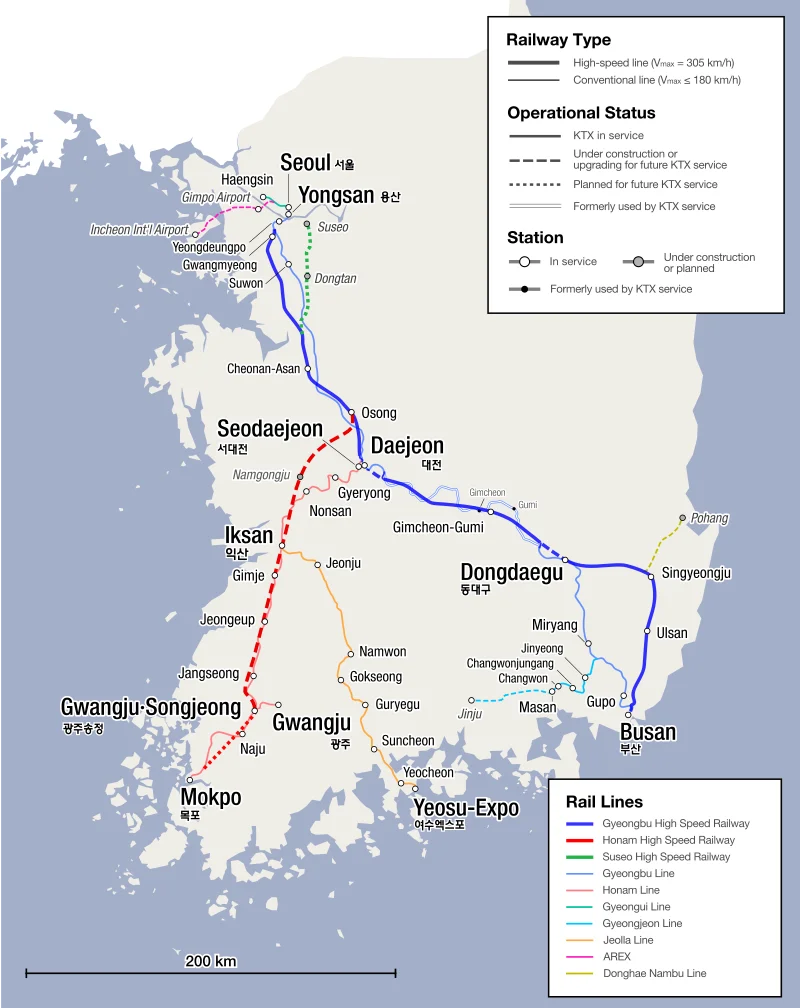 |
| South Korean Railway Route |
For the Philippines to truly unlock the economic potential of the "Big Islands" (Luzon and Mindanao), we believe we must move past the age of the truck and embrace the efficiency of the track.
We’d love to hear your thoughts—do you think the "Maritime-First" approach is enough for us, or are we decades behind on the tracks?
AI assistance (Gemini) was used to help draft and organize this blog post; the author takes full responsibility for the final content.

No comments:
Post a Comment